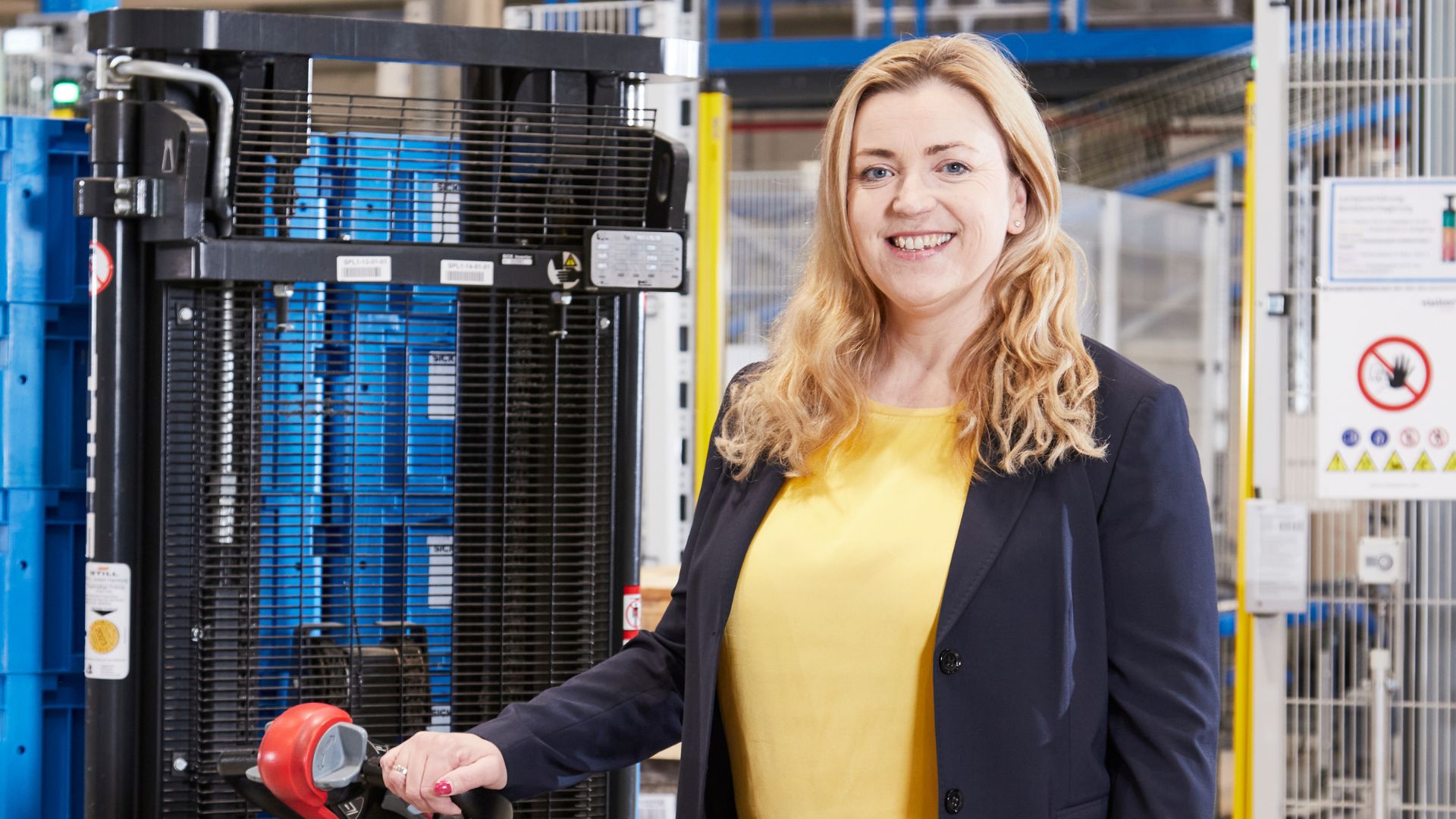
Ulrike Kahle-Roth Executive Board member for the newly created Supply Chain & Fulfillment portfolio at SICK AG since December 1, 2022. She spoke to us about disruption, raw material shortages and the intelligent supply network.
Ms. Kahle-Roth, what exactly do your responsibilities at the new Supply Chain & Fulfillment division include?
SICK has merged procurement, operations and fulfillment into one new Executive Board division. The goal is to use this structure to interlink the departments in a way that delivers the best possible results for our customers as well as to boost our productivity and throughput and optimize our performance in supply.
Why was this restructuring needed?
The impact that the various global crises in recent years have had on supply chains has presented a lot of considerable challenges, and we are not immune to that. We have managed to resolve many of them in the short term, but it is much more important for us to put ourselves on a new and more stable footing overall so that we can handle disruptions of that type.
How do we do that? By trying to anticipate all possible scenarios?
To some extent – but you obviously can’t foresee everything. Trying to prepare for all conceivable eventualities would also be prohibitively expensive. Irrespective of what may happen, it is crucial for us to think about how we handle such developments no matter why they occur. One way could be that we scrutinize our suppliers in more detail than we have previously, work with them more closely and carry out joint risk assessments. For example, just-in-time delivery used to be the goal, and it was implemented reliably. Today, though, we’re at a point where that is just no longer an option. One of the problems is that, in recent years, people have been filling their warehouses to the point of hoarding – and we are no exception. We need to get back to a point at which we work with the sales team and our suppliers to think carefully about what makes sense. This approach was one that already existed before the supply chain problems, but it rather faded into the background over the course of the last two crisis-hit years. Now, we want to come out of crisis mode and adopt a more long-term setup.
But if a supplier simply isn’t able to deliver a part that you need for production, what can SICK do about it?
That depends very much on the part in question. There are of course standard components that we can obtain elsewhere. But because we operate in a relatively specialist field, there are also a lot that we would need to try to get from other sources. However, we do also have some things that are produced for us alone. In those cases, we need to give our suppliers support to help them get hold of their components, and it goes without saying that we will do so. Alternatively, we can take over process steps from our suppliers and manufacture certain things or carry out certain steps in house so that we can continue to make our deliveries.
Have there ever been cases before when process steps have been brought in-house?
Absolutely. In industry, the pendulum is always swinging back and forth in terms of what you outsource and what you bring back under your own roof. It is important to us that we secure our capacity to deliver for the long term. That requires careful consideration. Bringing everything in-house wouldn’t make sense. We follow a nuanced strategy. We’ve always built a lot of our prefabricated parts ourselves. We do our own mechanical and electronic prefabrication, produce many of our own mechanical parts and fit our circuit boards with components ourselves. But we also purchase things externally. We call this combined arrangement “intelligent make and buy.”
With its intelligent supply network, SICK had already reorganized itself before the various crises hit. What exactly is that all about? And is that setup still holding up in light of current circumstances?
The Intelligent Supply Network, or ISN for short, for which I’m acting as executive sponsor, is meant to ensure that the global availability of our products matches the expectations of our customers. It is a mainstay of our new SICK Beyond Borders strategy, which we launched in 2021. This is about not only establishing a global supply chain in which all production systems are interlinked but also generating relevant data and plans in advance. That way, we can both run an extremely flexible production operation and also think ahead and plan in terms of scenarios for making sure that we are prepared. For example, we consider what could happen if supplies are interrupted, or simulate major orders from customers and find solutions to any problems that may arise. That way, we will be able to keep up with our customers’ demanding requirements in the future and to fulfill orders more quickly and efficiently. Our extensive product range makes it impossible to keep everything in stock, but we aim to give our customers clear and reliable information about when they can potentially expect to receive something and when they definitely will receive it.
I am absolutely certain that this is exactly the approach we need, and it’s more important than ever. Incidentally, another major element of the ISN is collaboration – with our suppliers, as I explained previously, but also with our customers.
Collaboration with customers – what does that mean?
It’s a matter of getting customers more involved in the supply chain. We’re already doing well in that respect. Personally, I enjoy talking directly to our customers, and they appreciate our honesty – for example, the fact that, if we have a problem with delivery capacity, we say so. Of course, our sales team also advises our customers on what would be alternatives if there were a shortage or which combinations would be advisable. That allows us to allocate our capacity appropriately and to give priority to particularly urgent or important orders. We have gotten a lot done with that approach in a time of crisis. However, we naturally want to move away from putting out fires here and there and toward implementing our strategy in a more long-term way.
How do we do that?
Ideally, we would like to have a mixture of items produced to order and those kept in stock, taking framework agreements and customer forecasts into account. That allows us to offer a high level of delivery capacity for customers placing orders at short notice but also to offer on-time delivery exactly as requested to customers who have already placed long-term orders. We want that to go as far as offering complete transparency in our online store, which now includes specific information about the characteristics of our products as well as their availability, which customers can use to make decisions. If we have delivery problems with a particular product, we are hoping in the future to suggest alternatives that can be delivered sooner. It is important, for example, to prevent situations in which a customer might order a highly complex part that needs to be custom manufactured for that specific customer when a different, simpler product that can be delivered much more quickly would do the job perfectly well. All these online store functions go hand in hand with our stock and transportation management operations. When a customer logs on, we can see where that customer is located, which enables us to show appropriate information about our products depending on the warehouse from which they would be delivered. All of that is already operational, and we are working hard to expand it.
And finally, a personal question. Do you believe that we are going to see a return to calmer times?
I don’t think there’s ever been a time when so much has changed so rapidly as right now. There’s going to be a lot more disruption in the future than has ever been the case before as well. I find that incredibly exciting. An awful lot of what we have learned – and I include myself in that – doesn’t apply any more. We need to rethink things entirely. We should seize the momentum created by these changes and make creative use of it. That is how ideas that are innovative and disruptive in their own way are born – ideas that would perhaps never have been given the time of day before.
Ulrike Kahle-Roth
Ulrike Kahle-Roth was born in Kehl in 1976. She earned an MBA before occupying various supply chain roles at the Dow Chemical Company, most recently as Customer Service Director for EMEA. She then moved to A. Schulman Europe GmbH, a leading company in plastic compounding, as Senior Director of Global Supply Chain. Kahle-Roth joined SICK as Senior Vice President of Customer Fulfillment in 2019, becoming a member of the Creator Team for the Intelligent Supply Chain Network strategic initiative. She took charge of the Executive Board’s new Supply Chain & Fulfillment portfolio in December 2022.