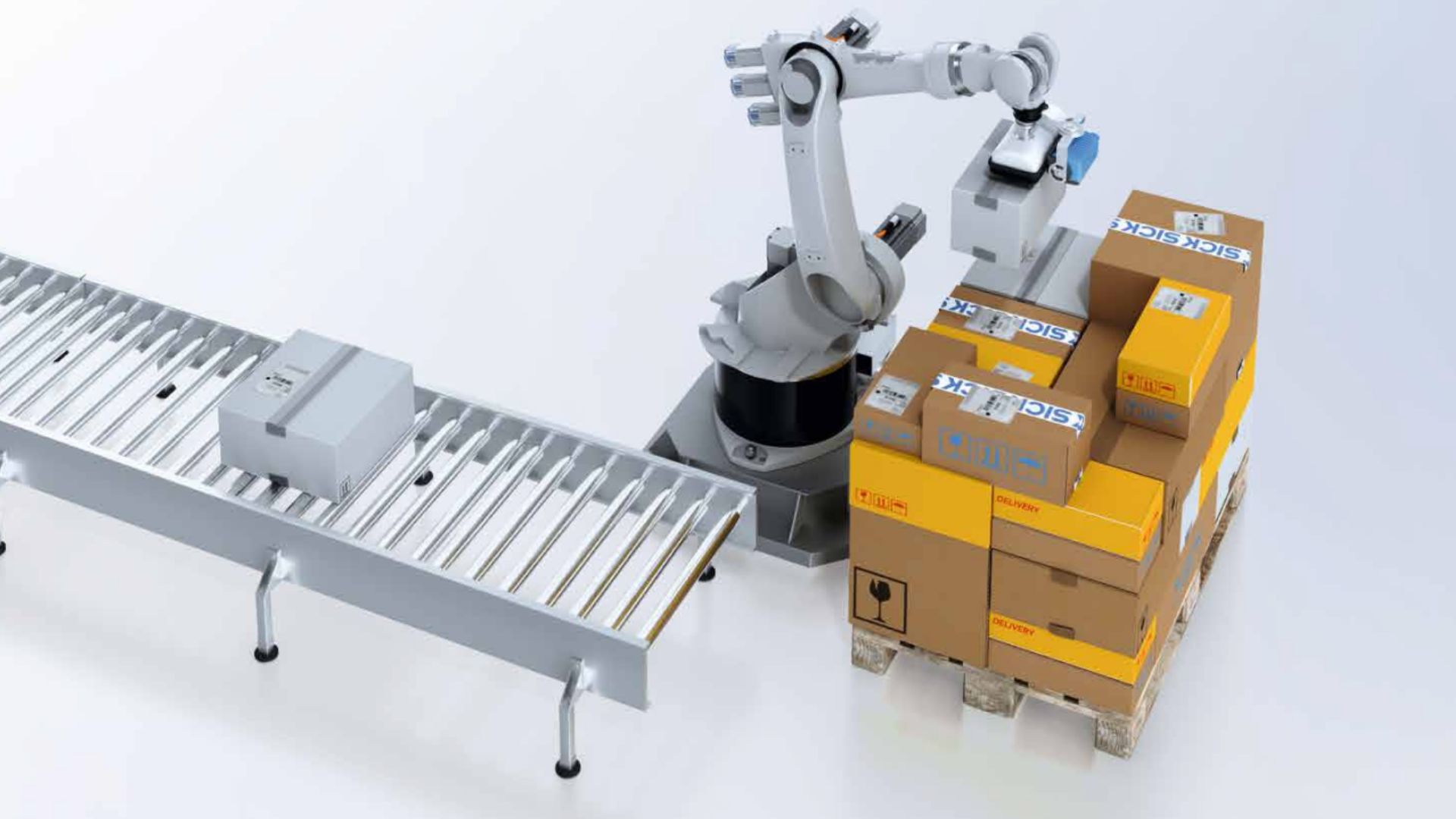
Wherever large quantities of products or goods have to be transported, you’ll find pallets. All too often, the laborious and monotonous task of loading and unloading them is still done by humans. High time for PALLOC: SICK’s AI-assisted localization system, which effectively teaches industrial robots how to depalletize.
They’re standardized, often made of wood, and there are currently millions of them – most of them brimming full – underway in international economic flows: pallets. Here, what counts most is efficiency and speed: once they’ve arrived at their destination, their contents need to go to production, the warehouse, or be shipped further as soon as possible – no matter how varied those contents are. So far, this arduous and monotonous job has been left to humans or highly complex robotic solutions.
What was missing was the intelligent integration of AI: “We analyzed the robotics trends identified by various independent market research institutes and listened to what many of our customers, robotic systems integrators from the logistics and consumer goods sectors, had to say,” recalls Maik Ahlers, Market Product Manager Robotic Solutions at SICK, explaining the reasons behind developing PALLOC (PALlet content LOCalization). “Our customers wanted a way to achieve 24/7 operations and to overcome the lack of qualified staff using accelerated, robot-based ‘plug & play’ automation.” With our camera system PALLOC, we can meet those needs.
Integrating deep learning
To do so, PALLOC combines SICK’s tried-and-trusted 3D snapshot camera Visionary-S and a pre-installed and pre-trained neural network integrated in the camera, which eliminates the need for an expensive industrial PC. It also features – and this is what sets it apart – a deep-learning-based depalletizing algorithm. The result: a uniquely compact robot guidance solution that measures the contents in seconds. Installed on a robotic arm or in a stationary position over the pallet, the system can rapidly recognize a theoretically unlimited number of box variants on the pallet’s topmost level, identify their cubic (or square) shape, and transmit the positioning coordinates to the robot control system. “Unlimited number” because, thanks to a user-friendly suite of AI tools, an unlimited number of further box variants can be added to the factory-installed neural network, which has already been trained for a broad range of boxes. As such, PALLOC, which, thanks to web technology, doesn’t need a separate industrial PC, is surely one of the most future-proof robot guidance systems of its kind. Moreover, its Ethernet link allows it to be integrated as a stand-alone solution to control virtually any cobot or industrial robot.
Putting human expertise in the sensor
A key difference from previous depalletizing solutions is the use of integrated deep learning in conjunction with the high-performance camera. The deep learning method allows the system to be trained using images and examples and develop new assessment techniques. In this way, human experience is essentially integrated into the sensor, constantly improving its accuracy. SICK has the requisite deep learning and camera expertise to merge artificial intelligence and sensor technology. As a result, Peter Nilsson, Strategic Product Manager in cooperation with Market Product Manager Maik Ahlers in Germany, was able to accelerate the product’s development: “Together with our specialized Robot Guidance team and a Sweden-based Vision Team, we drew on the existing Visionary-S camera technology to develop the robotic guidance system PALLOC in just over twelve months.”
Speed and SICK’s consistent focus on ease of use are also reflected throughout the product. “On site, our localization system for robot guidance can be installed in less than an hour, the sensor can be quickly and easily mounted, there are plenty of connectivity options, and no in-depth programming skills are needed for the AI,” says Maik Ahlers, summing up the system’s benefits.
Further variants already planned
It’s hardly surprising that there’s considerable interest in PALLOC in the logistics sector and consumer goods manufacturing. Accordingly, further variants are already planned, e.g. for identifying the frequently used, standardized Euro-boxes (KLT boxes) or for bags.
And what about AI-assisted depalletizing for crates of all shapes and sizes? Maik Ahlers has to smile: “Tailor-made depalletizing for cubic crates of different sizes, or what we call mixed depalletizing, is still a technical challenge on a rapidly growing market. It’s also the next stage of development that SICK is already focusing on.”
So, rest assured: SICK’s development of products tailor-made for customer needs is picking up speed.
Tailor-made depalletizing for cubic crates of different sizes, or what we call mixed depalletizing, is still a technical challenge on a rapidly growing market.