
Deep Learning from SICK opens up new avenues in industrial automation – making it possible to automate increasingly complex tasks and to do so more easily. SICK Nova’s AI tools allow sensors to be trained for customer- specific tasks with little effort.
“Artificial intelligence (AI) is really Nothing new,” says Dr. Ola Friman, Head of R&D Intelligent Machine Vision and Head of Deep Learning Framework Autonomous Perception at SICK’s Linköping site in Sweden. “In recent years, however, much more data has become accessible, and the available computing power has multiplied. This opens up completely new fields of application for us.”
The new AI technology, based on what are known as Deep Neural Networks, or Deep Learning, is known to be particularly good at interpreting texts and images. And that’s where SICK comes in: “Our smart cameras generate and process a wealth of images. AI allows us to use those images for new applications in industrial automation,” Friman explains.
One central AI solution offered by SICK is SICK Nova. The software runs directly on SICK sensors and cameras and provides the basis for configurable image processing solutions that are suitable for a wide range of industries and applications. SICK Nova is currently pre-installed on six 2D and 3D sensor models and uses a variety of imaging technologies.
Thanks to its extremely userfriendly web interface, virtually any user can implement even advanced applications quickly and easily, even without prior knowledge or programming skills. In addition, users can easily extend the functionality of the software with plug- ins of their own design, making the solution a safe investment and highly scalable.
Intuitively operable web interface
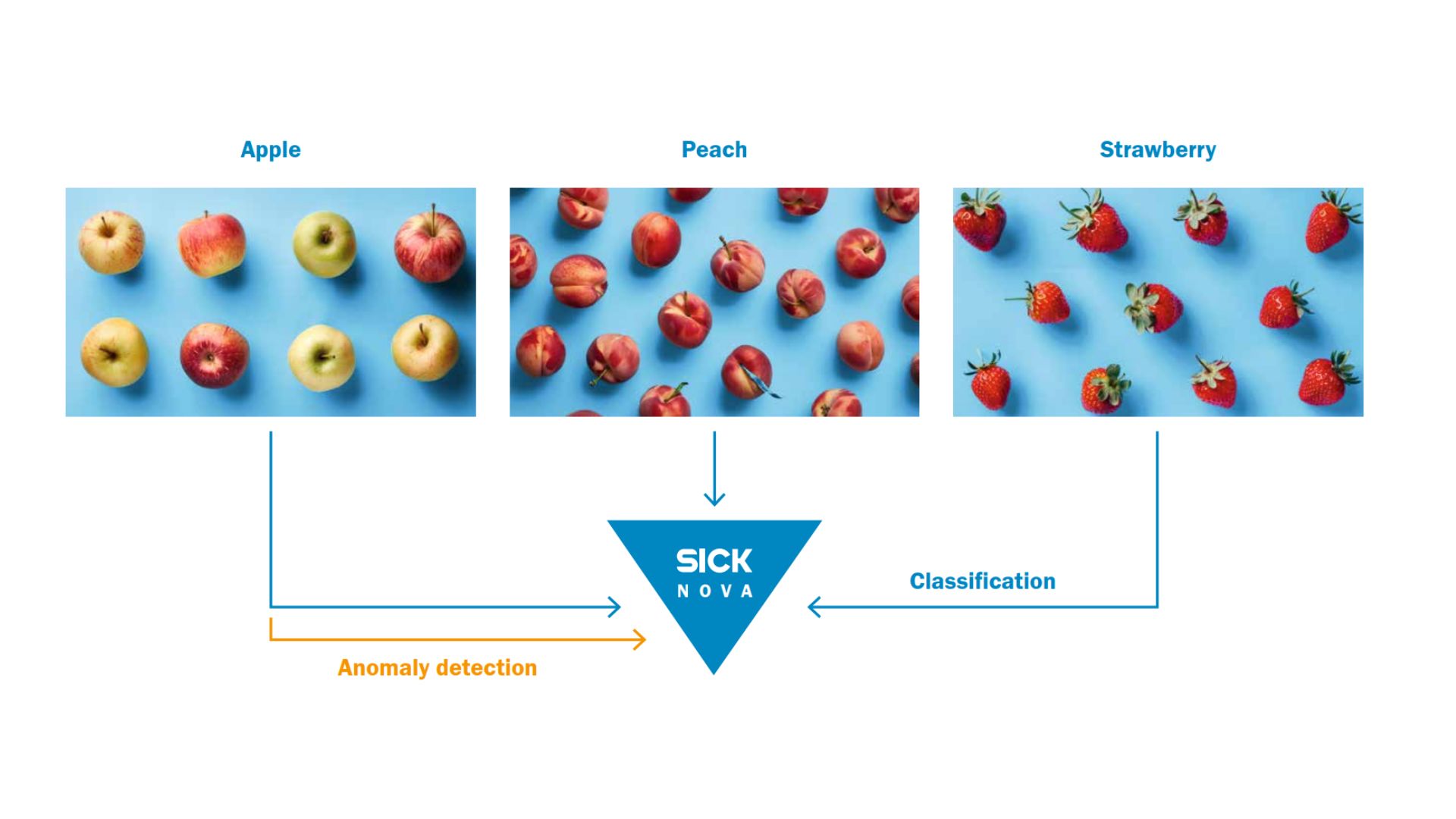
Viktor Smedby, Strategic Product Manager 2D Vision Autonomous Perception in Linköping, explains how the AI tool in SICK Nova works in practice: “SICK Nova has all the traditional tools for image-based quality control, such as measuring a distance or a diameter for tolerance-checking. With the AI tools it offers, you can also entrust the sensor with complex recognition tasks, like sorting objects.” To do so, however, the AI must first be trained – which is child’s play with SICK Nova’s intuitive web interface.
“The user places the object to be recognized in front of the camera several times, in different positions, and has it take the corresponding pictures. They then ‘code’ all these images as a product class. This process is repeated with the objects of other product classes. That’s already enough to train the artificial intelligence directly on the sensor so that it can reliably distinguish between these objects,” says Smedby. If the requirements change, the sensor can simply be reset using the “Reteach” button. “The sensor then collects the next images, learns from them, and continues its work independently. As a result, it only takes a few seconds to learn a new product variation or design.”
Reduction to a clear and simple decision
If the number of different objects to be sorted is extremely large, or if the required computing power exceeds the sensor’s capacity, SICK’s dStudio can help: “This is a cloud software package with significantly more computing power than the sensor itself has room for,” explains Ola Friman.
Users can simply upload large quantities of image files that they have previously sorted and classified. dStudio then takes over the training of the deep neural network.
“Back on the sensor, this AI application can reduce a complex problem to a clear and simple decision and execute it independently,” says Friman.
Defining deviations
This classification and sorting application is particularly valuable for the manufacturing industry, where packaging designs can change quickly. “In April 2024, we’ll launch a new AI camera sensor, the Inspector830, with even faster performance,” says Viktor Smedby. “We are focusing on the consumer goods and packaging sectors, where faster speeds are generally required. We’re convinced that this is an innovation that will take our AI solutions’ performance to a whole new level.” But SICK Nova can do more than classify objects. In August 2023, a second AI feature was launched – the “Anomaly Detection Tool,” a function that puts SICK ahead of its competitors: “The AI is trained to recognize what a ‘correct’ object or product looks like. Any deviation from that standard is detected and discharged – without the user having to define what these deviations might look like,” Viktor Smedby explains. “It doesn’t get much easier than that.” Yet another AI function is the ability to locate complex products or objects in front of a sensor, something that is particularly interesting in connection with the use of robots for automatic object picking or for avoiding collisions with detected objects. “We’ll continue to develop AI innovations within and around SICK Nova, with a focus on both reliable performance and ease-of-use,” Ola Friman concludes.
Machine vision made easy
SICK Nova is the foundation software for configurable machine vision solutions in a broad array of industries and quality control applications. Featuring a userfriendly web interface and AI capabilities, SICK Nova supports experts and non-experts alike so they can quickly and easily handle even the most challenging applications. SICK Nova runs on a multitude of 2D and 3D vision sensors, leveraging different imaging technologies. Moreover, users can conveniently extend the software’s functionality with both user-developed and ready-made SICK Nova plug-ins. With this kind of scalability, SICK Nova is a safe choice that ensures cost-effective ownership.