The extraction of raw materials in limestone quarries presents numerous challenges with operators of large machinery working together in confined areas. The minerals extraction sector faces increasing pressure to structure safe and cost-effective work procedures and processes. Because of their massive size, large mobile machines such as bucket and shovel excavators, haul trucks and wheel loaders, have considerable blind spots that impair operator visibility.
Therefore, accident-free navigation of mobile machines as well as efficient and safe loading and unloading of vehicles are major everyday challenges in limestone quarries. Long work shifts, harsh weather conditions and difficult terrain additionally increase the risk of accidents. However, sensor-controlled driver assistance systems provide safety.
Guidance and collision awareness
To support drivers in critical situations, sick has designed special guidance and collision awareness solutions: minesic100. These driver assistance systems usually comprise one or multiple Light Detection and Ranging (LiDAR) sensors for environmental sensing around the vehicle, a GPS system for location and speed information, cabling, evaluation unit with operator display and advanced software for situation-specific warning strategies and visualisation.
Technology for best-possible results
Sensors that use lasers to perform non-contact distance measurements have become an integral part of automation engineering.
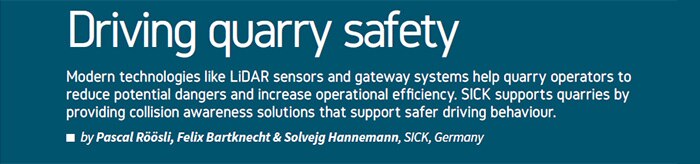
Sick uses this state-of-the-art LiDAR technology to provide the information needed for driver assistance. Inside the minesic100 scanners a laser beam is deflected across a rotating mirror (see Figure 1). The sequential order of the laser pulses is synchronised with the rotation frequency of the motor and the required angular resolution. Generally, the motor rotation speed is determined by the maximum emitted pulse frequency of the laser source and the desired angular resolution. Using time of flight (TOF) evaluation the sensors can detect obstacles around the vehicle.
Gateway systems for more transparency
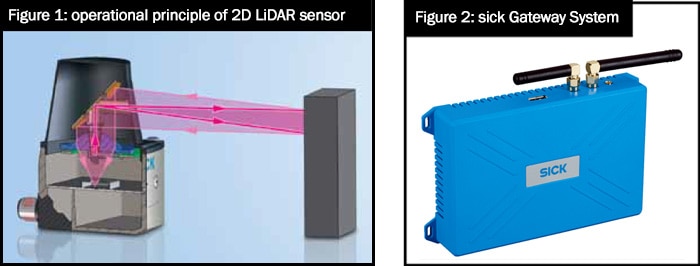
The laser-based anti-collision and lane departure systems for trucks, wheel loaders and excavators are usually connected to a telematic data collector (TDC) (see Figure 2), which gives the operator additional information about the location of the vehicle by providing GPS data. Combining position data with the statistical frequency of cases in which drivers are warned about critical driving or risky situations provides operators with important information about the most dangerous areas for humans and machinery in a quarry. Taking this information into account can help optimise driving routes and accelerate quarrying processes while minimising accidents.
Sensor data optimise quarry operation
Both collision avoidance and operator assistance must be addressed by the system simultaneously. However, operators will not accept a new technology if the system is handling collision avoidance while distracting at the same time, for example, by providing an alert for all objects around the vehicle. Likewise, a passive system will not attract the operator’s attention on time in critical situations thereby failing to achieve a sufficient reduction in the accident rate. To meet these challenges and customer needs, proximity detection solutions such as sick’s LiDAR-based systems, which include an integrated object detection algorithm and warning strategy, can take both needs into account at the same time.
MINESIC100 guidance and collision awareness solutions were, therefore, developed to achieve a high operator acceptance and not distract. These systems adopt behaviour recognition, automatic warning zone adjustment and context switching according to different driving manoeuvres. As an example, the minesic100 EPS installations on large excavators monitor and detect their environment with an almost gap-free 2D LiDAR sensor, regardless of whether the objects are moving or not. The advance application software uses the mounting position, excavator size, tail swing radius, safety margin, truck spotting radius and maximal loading area for detecting and processing object information such as position and size. As a result the system only warns actively for obstacles on a collision path, without the necessity of tagging the object or infrastructure before. Therefore, collisions between the excavator and the highwall face in a limestone quarry can also be avoided at the same time.
In addition, objects and the infrastructure in the quarry are displayed as object outlines on a display. The visualisation is simple and distances are visible without the need to interpret a camera picture. This solution reduces accidents, while the operator can observe his surroundings and maintain safe distances.
Excavator protection
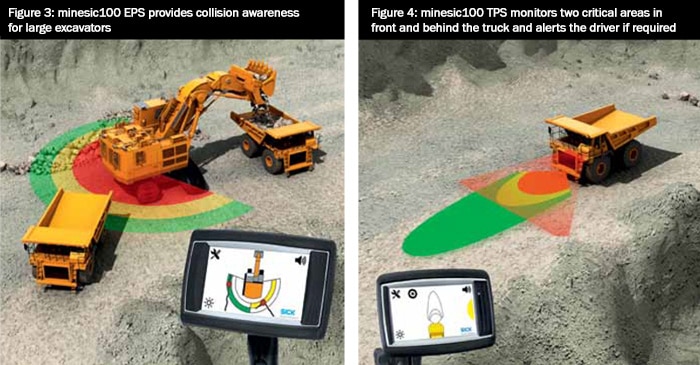
The minesic100 EPS is a collision awareness solution for large excavators (see Figure 3). It provides the excavator operator with warnings to prevent collisions with other vehicles and the highwall face. It also assists the operator with correct vehicle positioning and the safe loading of haul trucks. Obstacles surrounding the excavator are indicated on a display. The operator receives visual and audible warnings in advance to ensure appropriate safety distances are maintained. This ensures that the operator can both manoeuvre the vehicle efficiently and safely, and complete loading operations accurately.
Truck protection
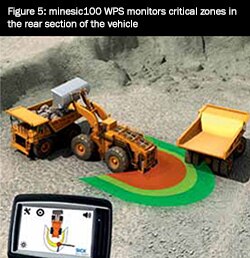
The minesic100 TPS is a warning system for collision prevention and lane monitoring (see Figure 4). It monitors the two critical areas in front and behind the truck and warns the driver as necessary. It also determines the position of the truck on the road. If the truck veers too close to the edge of the road or unintentionally infringes upon the opposite lane, the driver is warned. If the driver intentionally leaves the road, ie, to make a turn or dodge an obstacle, the system recognises this behaviour and does not emit a warning.
Wheel loader protection
The minesic100 WPS is a highly-precise collision awareness system for infrastructure obstacles. Embankments and stockpiles present a considerable collision risk. When loading and unloading, wheel loaders are continuously moving forward and backward, while the main attention of the operator is focussed on the bucket. The minesic100 WPS monitors the critical zones within the rear section of the vehicle (see Figure 5). The system sends a warning signal when there is a risk of collision and provides assistance to the operator during difficult manoeuvres.
Reducing downtime and maintaining focus
Many quarry operators worldwide trust in minesic100’s guidance and awareness solutions to prevent collisions in dangerous areas. The use of this technology results in reduced downtime and repair costs by guaranteeing high machine availability and trouble-free operation. The active situation-dependent warning with low false alarm rates helps to detect and track moving and stationary obstacles without the need for RFID tags. The integrated black spot warning (geo-fencing) for hazardous areas and an integrated installation wizard simplifies installation and operation. Self-diagnostic functions make system maintenance easy, enabling the operator to stay focussed on the main task
Click here view "Driving quarry safety" in pdf