Greater safety, accuracy, efficiency in every respect - Shape the digital world of tomorrow with sensor solutions from SICK.
Learn more
Home Industries Industries Electronics sensor solutions for the electronics industry
The electronics industry is one of the strongest drivers of innovation in industrial development. It is characterized by rapid change, highly complex manufacturing processes and the constant demand to provide ever more powerful components in the shortest possible time. Whether microchips or high-tech systems: Reliability, quality, efficiency and continuous development are crucial to meeting the increasing demand for high-performance electronics.
With its comprehensive portfolio of sensor technologies, SICK supports the electronics industry along the entire value-adding chain. Our solutions optimize key process indicators such as output, time-to-market, error rate, transparency and operational safety, thereby providing the foundation for stable, efficient and future-proof manufacturing processes.
ATEX-certified sensor solutions for hazardous areas
High temp
Sensor solutions for reliable measurements at extreme temperatures
News
The Hermes Standard – retrofitting of SMEMA systems made easy
Uniform machine-to-machine communication protocol and a standardized vertical connection of machines to higher-level IT systems accelerate the transformation to the Smart Factory.
Sensor solutions help the electronics industry to produce more sustainably by recording precise data, detecting deviations early and thus reducing energy and material consumption as well as waste. At the same time, they increase plant availability through predictive maintenance, extend the service life of machines and reduce the carbon footprint. In addition, transparent, data-driven process optimization increases efficiency along the entire value-adding chain.
An AI-supported inline inspection system detects errors in real time, corrects deviations immediately and automatically adjusts system parameters. This reduces waste and material consumption, making production faster, more stable and more sustainable.
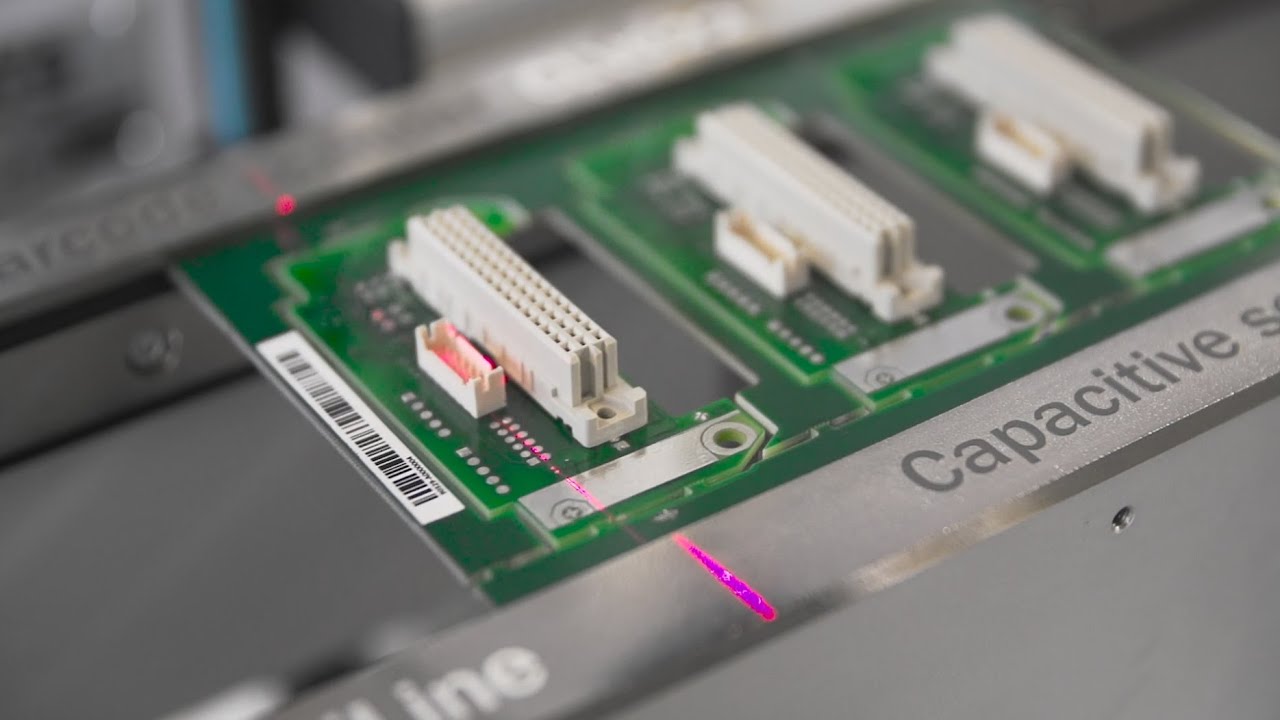
PCBs are manufactured and assembled in several steps:
First, the conductive track layout is applied to the base material and etched. This is followed by drilling, coating and application of the solder resist and labeling.
During assembly, the electronic components are mounted using the SMT or THT method, soldered and then automatically tested.
The result is a functional and quality-assured electronic assembly.
The Hermes standard enables an end-to-end digital data exchange between machines in electronics production. It automatically transfers product and process data from station to station, improves traceability and ensures that systems are automatically prepared for the next product.
This reduces downtime, makes processes more stable and makes the entire line more transparent and efficient.