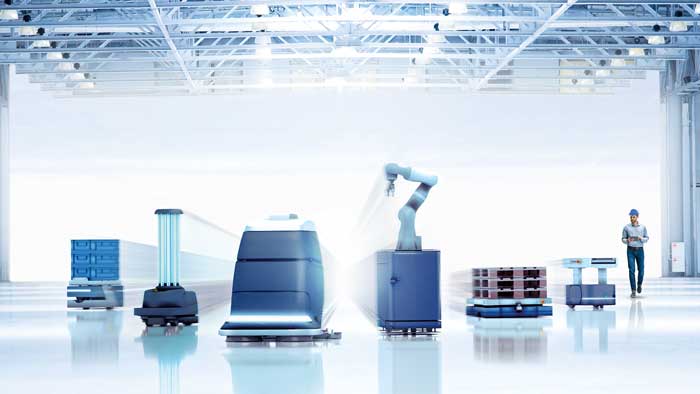
In warehouse logistics, for example, quick and flexible operations have become as important as in manufacturing. AMRs are a valid alternative to forklifts because they can pick, transport, and deliver material through dynamic environments autonomously, relieving humans from higher-risk tasks. The smart safety sensors they are equipped with allow them to navigate autonomously, moving through their surroundings without the need to be supervised by an operator or to follow a fixed and predetermined route.
H2 Safety sensors to navigate the working environment
Mobile platforms and AMRs move automatically and autonomously between different points in production or warehouse logistics environments. Smart sensors support mobile robots in locating, mapping and navigating, as well as during coordination phases and docking manoeuvres, allowing flexibility and freedom in positioning.
However, movement in free space requires much more.
Specific safety sensors, are needed to dynamically
adapt vehicles according to the driving situation, when cornering, navigating around obstacles, working in outdoor environments, and
avoiding collisions, that are one of the biggest challenges for AMRs. Every vehicle collision results in additional costs due to breakdowns and downtime.
The range of safety sensor solutions for AMRs is huge and from simple to high-end applications, each solution is uniquely designed according to the individual customer needs to ensure that tracking, positioning, or load handling can take place reliably. The are many sensor technologies available to customers such as LiDAR based devices, Radar, encoders, vision sensors, RFID and ultrasonic each with their own features and benefits.
H2: Safety sensors for mapping the environment: the human-robot cooperation
When people and mobile platforms share the same work environment any
human-robot collaboration activities must be safe and hazard-free. Also, mobile robots must
avoid both static and moving objects and always be able to
sense their surroundings.
Safety sensors enable the detection of humans or obstacles that robots encounter on the route, allowing them to safely navigate around them or come to a safe stop if obstacles get too close. To map the environment,
solutions based on safety sensors, such as safety light barriers,
safety laser scanners,
encoders and
2D/3D sensors ensure safety, enabling the protection of zones, regulates access to dangerous areas and helps
avoid potential collisions between objects and operators.
In addition to reducing the risk of collisions, autonomous mobile robots help to keep staff safe by taking over repetitive and risky tasks in unhealthy and or dangerous environments, allowing them to perform more value-added functions in safer conditions.
H2: Safety sensors for Industry 4.0
“Safety first” must be the claim for the company of the future. In a scenario where the future of production plants are increasingly characterized by
Human Robot Collaboration (HRC) , that is sharing of work areas between operators, robots and autonomous driving systems, the a
doption of adequate safety and security tools are essential. The use of safety sensors for risk reduction ensure that the
Required Performance Levels (PLr) are achieved for safety-related parts of control systems covering movement, speed and rotation and that they are in full compliance with the relevant standards for mobile robotics applications.
Performance Levels range from PLa (low) to PLe (high) and are defined by
ISO 13849-1.
Safety sensors made for
mobile applications such as AGV and AMR platforms, support these applications in tracking and
preventing collisions.
In order to reliably detect objects and people and maintain high availability, these safety sensors must have high resistance to the incidence of sunlight/ambient light, dirt and dust. Through the use of modern, innovative scanning technology safety sensors can now work in difficult environmental conditions.
By adopting measures based on suitable safety sensors, the overall risk is reduced for the employees and availability is increased on the machine, creating a safe and reliable environment, that maintains a high degree of productivity.