
Safe Motion know-how about drive safety functions according to IEC 61800-5-2
STOP FUNCTIONS
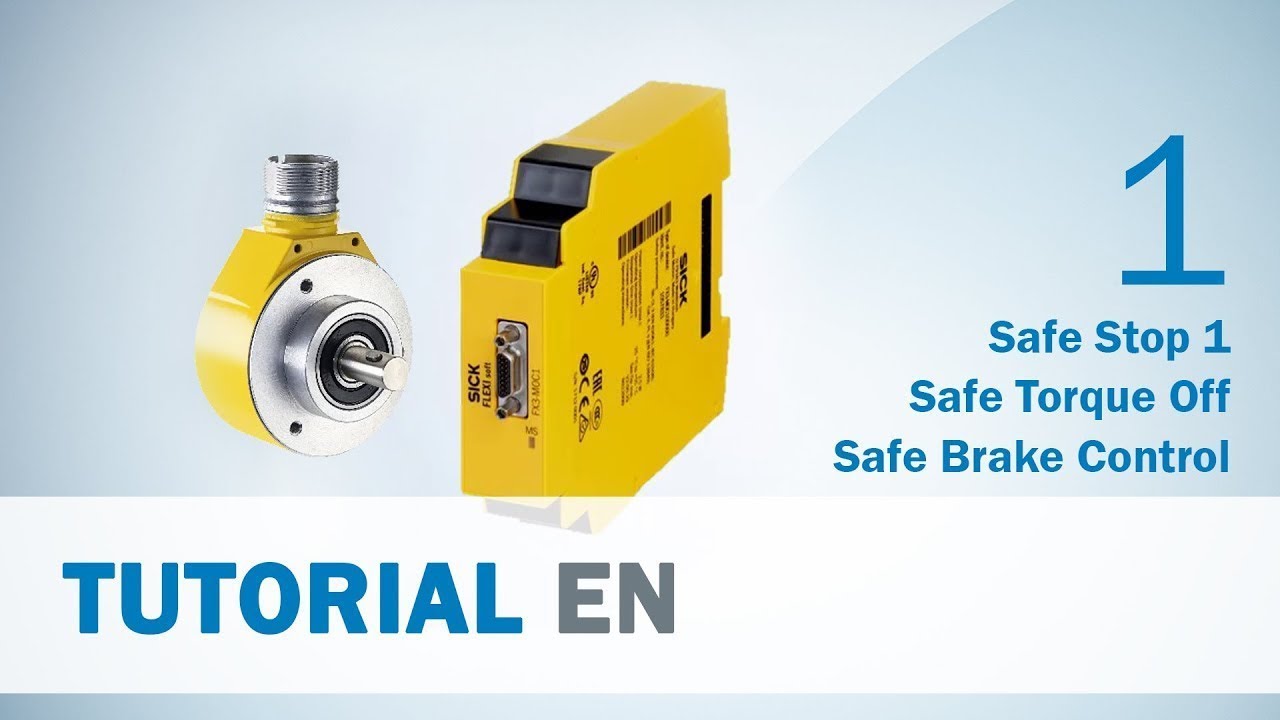
SS1 – Safe Stop 1
The safe stop 1 (SS1) stop function brings a machine to a controlled standstill and then switches off its drives. SS1 protects the personnel and the machine from dangerous movements caused by excessive mechanical braking.
For moving machine parts such as linear axes, SS1 monitors the brake ramps of the drives and de-energizes them after standstill using the safe torque off (STO) function. Depending on the configuration and safety considerations, SS1 first triggers the safe brake control (SBC) function and then STO.
SS1 corresponds to stop category 1 according to EN 60204-1.

SS2 – Safe Stop 2
The safe stop 2 (SS2) stop function brings a machine to a controlled standstill, but maintains the power supply to its drives. SS2 protects personnel and allows a quick restart of the machine for high productivity.
SS2 can also be used with mobile robots: The stop function monitors the electrical braking of the vehicle. This prevents a vehicle from losing transported goods and protects the personnel and vehicle surroundings. As soon as a mobile robot comes to a standstill, the safe operating stop (SOS) function monitors its standstill position. If the standstill limit values are exceeded, the safe brake control (SBC) function is executed first, depending on the configuration and safety considerations. SS2 then triggers the safe torque off (STO) function.
SS2 corresponds to stop category 2 according to EN 60204-1 and is not suitable for emergency stop functions

STO – Safe Torque Off
In the event of danger, the safe torque off (STO) stop function immediately interrupts the power supply to a machine. If, for example, personnel enter the hazardous area of a saw, the STO signal switches off the voltage supply of the motor – via an external relay, or directly via the STO input of the motor controller. In this case, no further rotational and braking torques are generated. The braking process is mechanical. Depending on the safety considerations, STO also triggers the safe brake control (SBC) function.
STO corresponds to stop category 0 according to EN 60204-1.

SPECIAL DRIVE SAFETY FUNCTIONS
SBC – Safe Brake Control
The safe brake control (SBC) output function can be used to control a brake. If, for example, a person reaches into a hazardous area during the downward movement of a press or cutting machine, this triggers a machine brake. SBC is activated by the safe torque off (STO) signal or in combination with safe stop 1 (SS1).
SBC is an output function according to EN 61800-5-2.

MONITORING FUNCTIONS
SOS – Safe Operating Stop
The safe operating stop (SOS) monitoring function monitors a position window of an axis at standstill. If the standstill position deviates from the defined stop position by more than a previously defined value, SOS activates the safe stop 1 (SS1) function.
If, for example, a tool or workpiece change takes place on a machine with the machine door open, the machine does not have to be disconnected from the voltage supply. The position information is retained to allow a direct restart.
SOS is a monitoring function according to EN 61800-5-2.

SDI – Safe Direction
The safe direction (SDI) monitoring function monitors the drive direction of mobile and stationary applications. In this function block you can define which direction of rotation of the drive is to be monitored. In the event of a movement in an unapproved direction of rotation, the system issues an error message.
Example: If a person or object is in the protective field of a safety laser scanner attached to an AGV, SDI prevents the vehicle from continuing to move in the direction of the person or object. The response to the error is defined in the control program.
SDI is a monitoring function according to EN 61800-5-2.

SLS – Safely-Limited Speed
The safely-limited speed (SLS) monitoring function prevents a predefined speed limit from being exceeded.
For example, SLS ensures that AGVs slow down in curves so they do not lose any of the load. The response to the error is defined in the configuration software of the controller.
SLS is a monitoring function according to EN 61800-5-2.

SSM – Safe Speed Monitor
The safe speed monitor (SSM) monitoring function safely monitors machine speeds. SSM monitors the speed of a drive, such as in a mobile rail-guided robot, and ensures safe transport of goods. The output signal indicates whether the speed is above a certain limit. If a limit value is exceeded, the connected safety controller triggers a previously defined error response.
SSM is a monitoring function according to EN 61800-5-2.

SSR – Safe Speed Range
The safe speed range (SSR) monitoring function monitors a speed range with upper and lower limits. This is important, for example, to detect when blocked drives or pumps are running at a too low or too high speed. This can result in overheating or other consequential damage. With the help of SSR, these can be detected early and a predefined error response can be triggered.
SSR is a monitoring function according to EN 61800-5-2.

SLP – Safely-Limited Position
The safely-limited position (SLP) monitoring function prevents a previously safely-defined position from being exceeded. SLP can be used, for example, for electrical limit switches on a linear axis and can limit their movements or enable the movements to run in parallel. Example: SLP can be used to limit the range of movement of a gantry crane so that it cannot endanger people.
SLP is a monitoring function according to EN 61800-5-2.

SCA – Safe Cam
The safe cam (SCA) monitoring function indicates, for example, when the position of a machine part is within a previously defined range. This function allows you to reliably detect the top and bottom dead center of a moving machine part. Using SCA, it is easy to implement a safe cam controller to distinguish between dangerous and safe movements.
SCA is a monitoring function according to EN 61800-5-2.
