Sicherheit ohne Kompromisse: Flexible Roboterzelle für mehr Produktivität bei Mills CNC

03.05.2022

Innovative und flexible Roboter-Fertigungszellen, die Sicherheit und Produktivität gewährleisten. Bei Mills CNC wurde die passende Sicherheitstechnik von SICK erfolgreich in diese Roboterzellen integriert – und gleich auch mit so einigen Mythen aufgeräumt.

Der Einsatz von Robotern entlastet das Personal vom Heben schwerer Lasten oder sich wiederholenden Aufgaben und kann eine gleichbleibend hohe Produktqualität in einem Rund-um-die-Uhr-Betrieb gewährleisten.

Flexible Fertigungszellen sind ein Eckpfeiler der Industrie 4.0. Sie können Produktionshallen revolutionsartigen Neuerungen unterziehen, indem sie sie von konventionellen, festen, oft linearen Prozessen befreien und so kürzere Produktionsläufe, höhere Flexibilität und kürzere Lieferzeiten ermöglichen. Der Einsatz von Robotern zur Bedienung der Maschinen in einer flexiblen Zelle entlastet das Personal vom Heben schwerer Lasten oder sich wiederholenden Aufgaben und kann eine gleichbleibend hohe Produktqualität in einem Rund-um-die-Uhr-Betrieb gewährleisten.

Doch auf dem Weg zur Industrie 4.0 sind viele Hersteller zunächst zurückhaltend bei der Integration von flexiblen Zellen in ihre Produktionsabläufe: Habe ich den zusätzlichen Platz, um die Roboterzelle zu integrieren? Wird die Produktivität durch ständige E-Stopps verringert, so dass die Investition unrentabel wird? Ist die Integration zu komplex, zu zeitaufwändig oder zu kostspielig?

Schluss mit den Mythen

Diese und andere Fragen stellen sich potenzielle Kunden des im englischen Warwickshire ansässigen Werkzeugmaschinenspezialisten Mills CNC. Als führendes Unternehmen im Bereich Aufbau von Maschinenzellen mit Industrierobotern räumt Mills CNC nun mit bestehenden Mythen auf und liefert sichere und effiziente automatische Robotersysteme für Drehmaschinen, Fräsmaschinen und Bearbeitungszentren von Doosan als exklusiver Zulieferer in Großbritannien.

Für Mills CNC war die Integration einer konformen Maschinensicherheit in seine flexiblen Roboter-Maschinenzellen eine besondere Herausforderung, da naturgemäß immer noch ein relativ hohes Maß an menschlicher Interaktion erforderlich ist, laut Chris Ingham, Control and System Engineer bei Mills CNC.

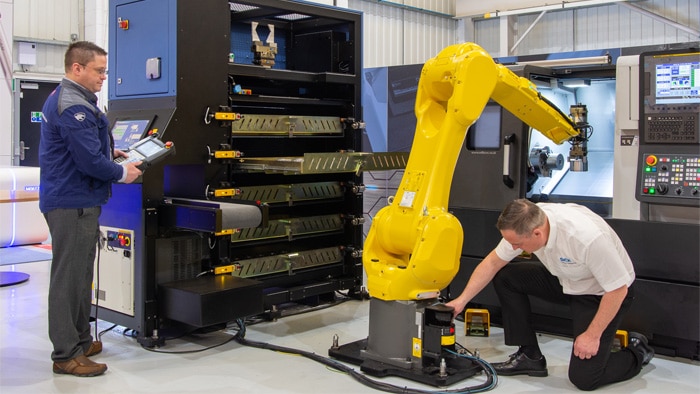
„Unsere neuen flexiblen SYNERGi Premier-Roboterzellen zum Beispiel, verfügen über eine Zwei-Wege-Belade-/Entladestation mit fünf automatischen Schubkästen“, fährt er fort. „Selbst bei diesem hohen Automatisierungsgrad ist die Einbindung des Bedieners unvermeidlich, um mit dem Fanuc-Roboter zu interagieren, der die Maschine kontinuierlich beschickt.“

Die neuen flexiblen SYNERGi Premier-Roboterzellen verfügen über eine Zwei-Wege-Belade-/Entladestation mit fünf automatischen Schubkästen.

„Außerhalb der Zelle bestücken die Bediener die Werkstücke und entnehmen die bearbeiteten Komponenten über die automatischen Zwei-Wege-Schubkästen. Währenddessen arbeitet der Roboter kontinuierlich innerhalb der Zelle, entnimmt die Werkstücke aus den Kästen und beschickt die Maschine, bevor das bearbeitete Teil wieder in den Schubkasten zurückgelegt wird. Das Einrichtungspersonal muss die Roboterzelle regelmäßig betreten, um die Werkzeugmaschine zu warten.“

„Bei automatischen Maschinenbeschickungssystemen besteht das Hauptziel darin, den Roboter in Betrieb zu halten, um die Produktionseffizienz zu steigern, und gleichzeitig die Flexibilität zu haben, Ersatzteile zu entnehmen und auszutauschen. Unsere kundenspezifische HMI-Software ermöglicht es, den Schubkasten mit so vielen Teilen zu bestücken, wie man möchte, oder alle fünf Kästen in einem Durchgang durchlaufen zu lassen. Es ist wirklich eine völlig flexible Lösung“, sagt Ingham und ergänzt: „Das Personal in der Werkstatt kann nun viel effizienter eingesetzt werden, da die Bediener und Einrichter in mehreren Zellen arbeiten und auch andere Aufgaben erfüllen können.“

Die Implementierung der Sicherheitstechnik war laut Ingham entscheidend für die erfolgreiche Markteinführung der gesamten Palette der flexiblen SYNERGi-Roboterzellen. Um die Vorteile des Konzepts der flexiblen Zellen zu wahren und zu fördern, mussten die Ausfallzeiten der Maschinen durch das Sicherheitssystem auf ein Minimum reduziert und für das Bedienpersonal zur nahezu nicht mehr feststellbaren Nebensache werden.

„Automatisierung sollte das Leben nie schwerer machen. Sie sollte es immer einfacher machen“, sagt Ingham und fügt hinzu: „Unsere Maschinenzellen müssen an die Arbeitspraktiken unserer Kunden angepasst werden, ohne dass die Technologie dabei zu teuer oder komplex wird.“

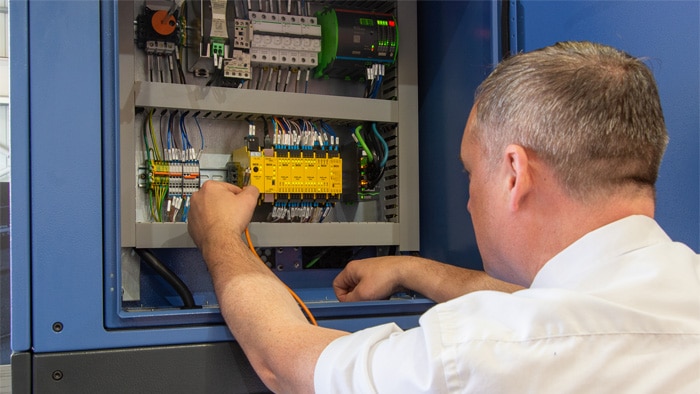
Daher wandte sich Mills CNC an die Spezialisten für Maschinensicherheit von SICK, und gemeinsam arbeiteten sie an der Integration von Sicherheitssystemen, die Produktivität und maximale Betriebszeit ermöglichen und gleichzeitig für die Betreiber völlig transparent sind.
Safety was a game-changer

“Implementing SICK’s network safety has been a massive game-changer for us in bringing the machines to market,” says Ingham. “Less sophisticated systems would have required a complete shutdown whenever the robot and operator inhabited the same space, requiring a reset and restart. They would have also required complex wiring that could have been difficult, if not impossible, to implement.”

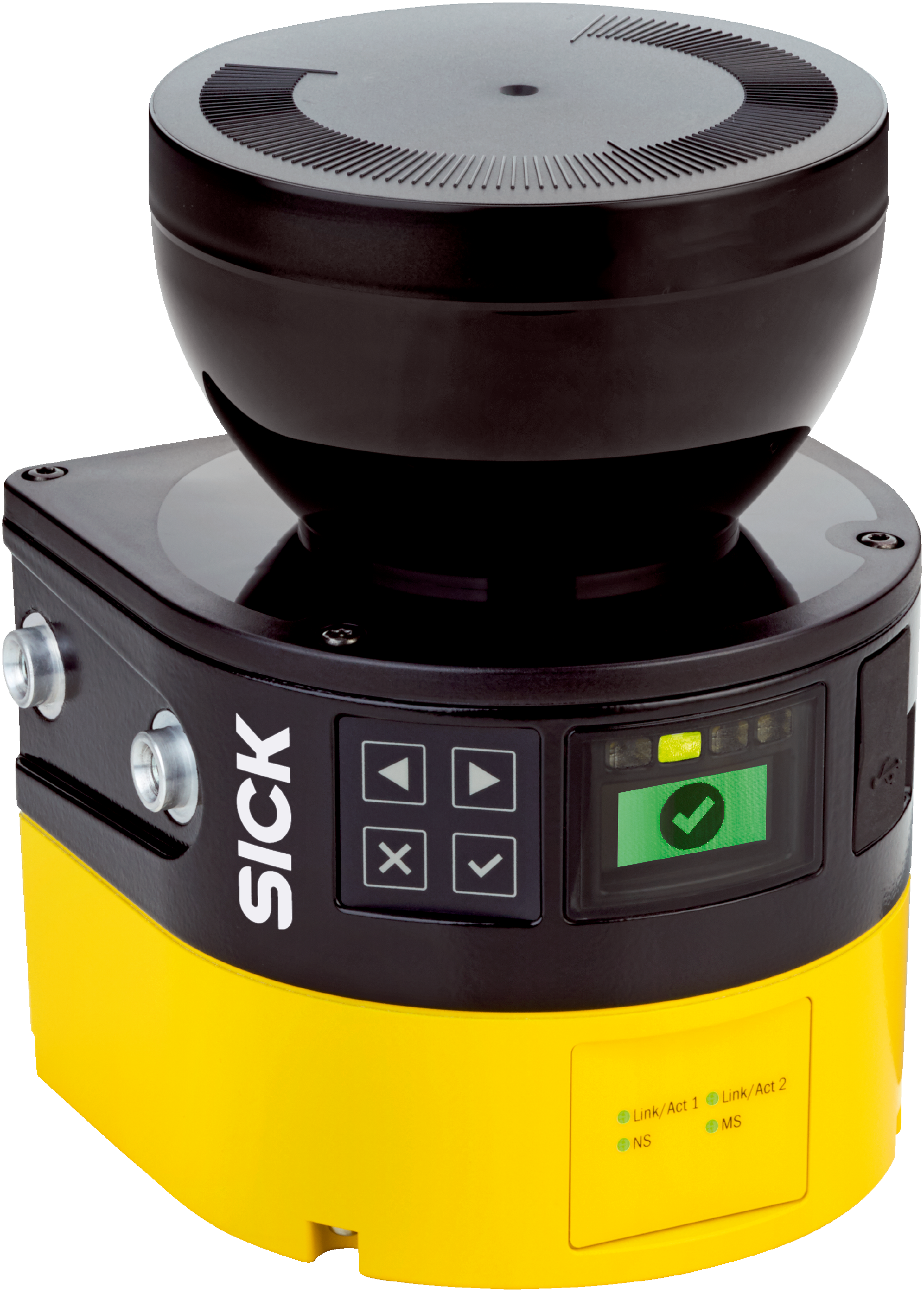
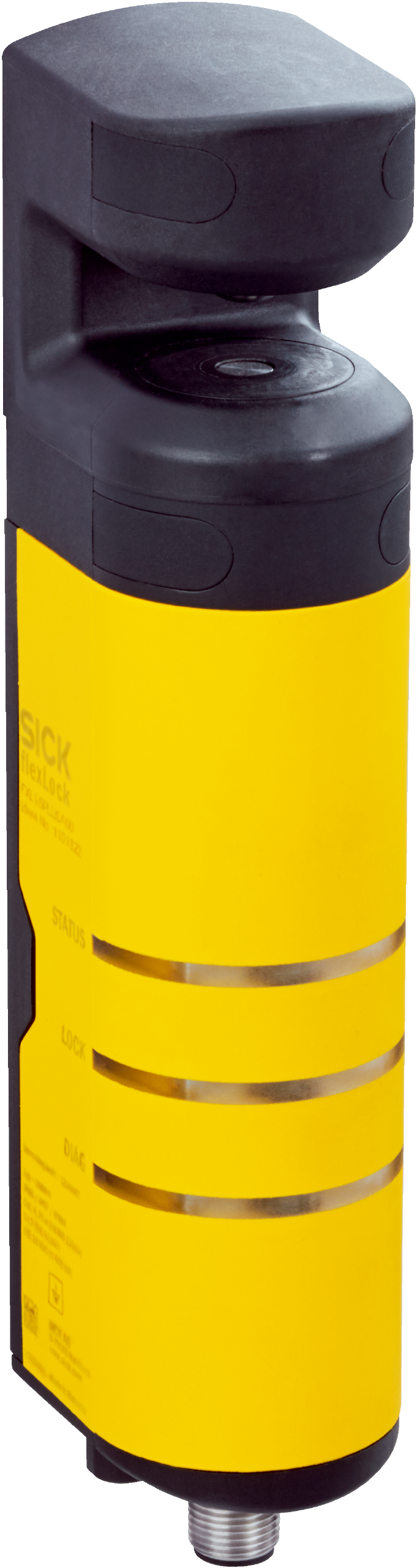
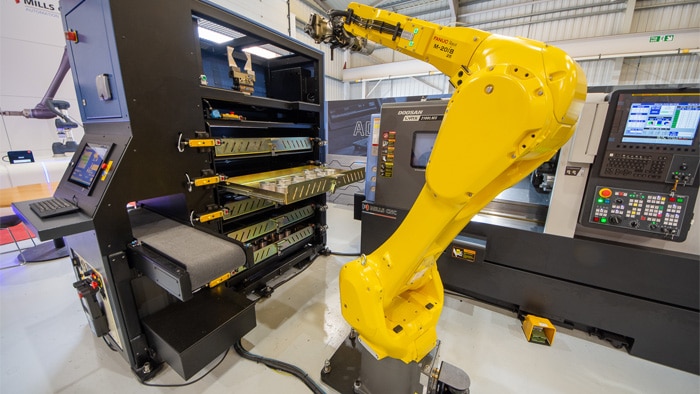
All Mills CNC’s automatic SYNERGi flexible manufacturing cells are fitted with the latest SICK sensor hardware. Each of the five automatic drawers of the SYNERGi Premier system is fitted with a SICK flexLock safety interlock with guard locking. A SICK microScan3 safety laser scanner is positioned at the foot of the robot to allow safe access for setters into the machine cell.

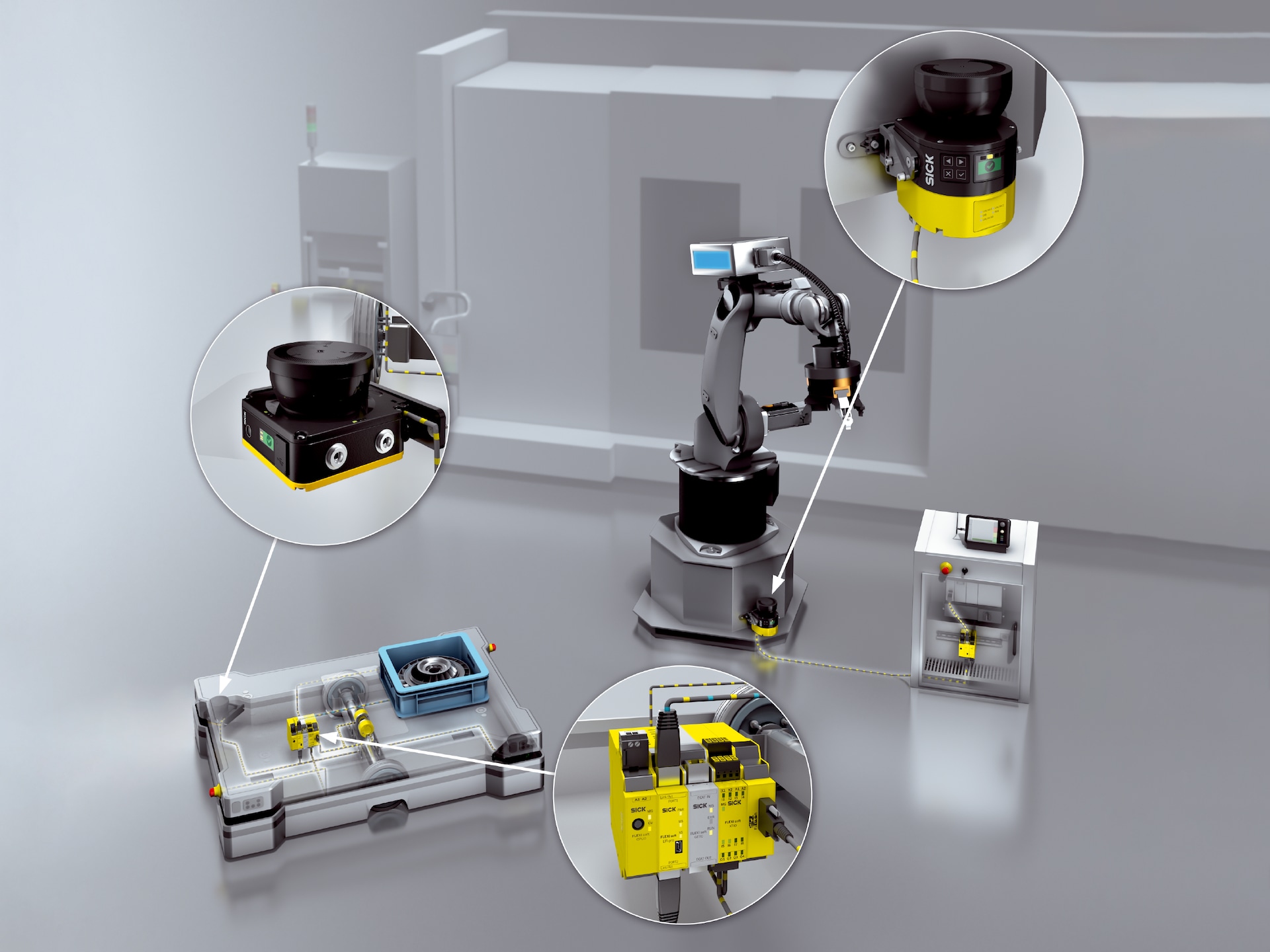
At the heart of the safety concept is the SICK EFI Pro network technology that supports direct integration of the SICK sensors and the robot controls via Ethernet/IPTM CIP SafetyTM up to SIL3/PLe.

The SICK Safe EFI-pro System is SICK’s safety network for industrial automation, based on the CIP Safety protocol.

“The number one challenge for us was finding a system that could talk natively, using the same protocols as the robot,” Ingham explains. “Without the direct connection through the SICK EFI-pro system over a single Ethernet cable, the integration would have been much more difficult, and more costly.

“The SICK flexLock interlock interacts directly with the Fanuc Dual Check Safety (DCS) control architecture of the robot cell system via CIP Safety. The DCS system enables me to draw 3-dimensional boxes around the drawer catches to restrict the movement of the robot and ensure clearance for the operator.”

The SICK Safe EFI-pro System is SICK’s safety network for industrial automation, based on the CIP Safety protocol. It enables safe communication between SICK EFI-pro devices like the microScan3, other SICK sensors, and third-party CIP-SafetyTM devices like robot controllers, through the SICK Flexi Soft safety controller and a SICK EFI-pro gateway. The SICK EFI-pro system also enables full remote diagnostics so that the system’s performance is recorded and monitored.

Mills CNC opt to use the 9-metre range microScan3 Core using SICK safeHDDM® multiple scanning technology on all their SYNERGi systems to control safe access for setters into the cell. The SICK safety system enables the scanner to be used as the primary safety device with two protective fields to slow the robot down before it enters a full stop.


Safety laser scanners
The rugged safety laser scanner – extremely intelligent
microScan3
Safety switches
RFID-monitored safety locking device with 180° actuation radius
flexLock
Safety systems
Safe integration for a productive interaction
Safe EFI-pro System


Floor space minimized

“Sometimes we have to shoehorn a machine into a very small footprint,” says Ingham “With the microScan3 you can minimize the floor space and by slowing the robot down and enabling continued operation, you are increasing productivity dramatically. The alternative would have been a fully enclosed cell and reduced uptime.

“Thanks to the SICK dynamic EFI-pro system, the fields can be set closer in, to take up less floor space, and the robot can continue to operate safely for as long as possible, so maximum uptime is maintained.”

SICK UK’s National Machinery Safety Product Manager, Martin Kidman, explains: “For Mills CNC, the EFI Pro system is allowing safe collaboration between the Fanuc robot’s DCS and the flexLock interlocking concept to perform complex safety-rated logic functions on the machine to the required standards.

Mills CNC have demonstrated a masterclass in delivering productivity through safety in their new SYNERGi automatic manufacturing cells.

“It enables direct data transfer to the safety control of the robot over one Ethernet cable with no hard wiring. Without this, each safety function would increase the wire capacity exponentially. A complex system such as this would need hundreds of wires or could even be completely impossible.

“Downtime is the enemy of any production process. Mills CNC have demonstrated a masterclass in delivering productivity through safety in their new SYNERGi automatic manufacturing cells. With the benefit of the SICK safe EFI-pro dynamic network safety, we have been able to work in partnership to engineer a complex system from a safety point of view, that achieves ease and simplicity with seamless integration for Mills CNC customers.”


Read more

Here comes HORST: An easy-to-use industrial robot from fruitcore robotics

Read more

SICK and MasterMover – Safe Starting Points for Industry 4.0

Read more